"Seventh Graders and Sexism" by Lisa Espinosa
Espinosa views teaching as a way to challenge students to think critically about societal inequity. She is a third-year 7th grade English teacher in a predominantly Mexican neighborhood of Chicago, where she noticed a gap between the expectations for girls and boys.
Girls are expected to...
- Cook & do chores
- Be nice & obey authority figures
- Dream of marriage
Boys are expected to...
- Be leaders & heads of family
- Be independent & strong
- Express their thoughts and ideas
- Dream of an education or a career
Additionally, there were conflicts arising in her school surrounding both gender and sexuality (i.e. rivalries between girls, girls accusing boys of touching them, boys being called gay for acting outside gender norms).
To combat this, Espinosa wanted her students to think about and understand...
- Why girls took a backseat in class discussions
- Why girls had rivalries instead of unity
- Why girls attached their worth to their appearance
- Why boys were afraid to express empathy and vulnerability
- Why boys used homophobic language
- How boys related to girls in the class
Espinosa asked students to brainstorm what it meant to "Be Ladylike" and "Act Like A Man." Students at first said their stereotypical ideas were the "truth" but soon began to understand that they come from families and media, and have no factual, biological root as Espinosa questioned their reasoning.
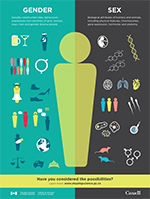
Brief science tangent: Biologically speaking, sex is more of a correlation of different traits than a simple description of what organs you have (intersex people exist!), what chromosomes you have (people can have XXY and all kinds of combinations!), what hormones are produced by your body, how your body responds to those hormones (not all people have functioning androgen receptors), how your secondary sex characteristics develop, and so on. Neurologically and physiologically, other sex differences are minimal, and only the extreme ends of the bell curves of each sex don't overlap. In other words, we're way more alike than we are different.
To encourage them to reflect more deeply on their biases, Espinosa exposed her students to articles about sexism and rape culture, and asked them to free-write stories about people facing gender or sexuality-based discrimination. They analyzed pieces of media and how they perpetuate stereotypes and expectations for young girls and boys.
Espinosa acknowledges that many of her students still expressed gender stereotypes by the end of the unit, but many of them began to start conversations on media they had seen recently that perpetuated stereotypes. Students still felt like sexism was too big of a problem to solve, but they made significant progress in thinking critically about the media they consume.


Annika, this is a super helpful summary. I really appreciate your "science tangent" as well. I also appreciate that you explained how Espinosa acknowledged that students still demonstrated stereotypes at the end of the unit, but this unit opened up these conversations for students to understand and explore sexism and its effects on their lives. Thank you for your insight!
ReplyDeleteThank you for this summary and illustrative graphic! I love how the author opens the space for a difficult conversation, which is as we learned, necessary to enact change. Nothing can change if you can't say the words
ReplyDelete