Saturday, July 4, 2026

Seventh Graders and Sexism

 "Seventh Graders and Sexism" by Lisa Espinosa

Espinosa views teaching as a way to challenge students to think critically about societal inequity. She is a third-year 7th grade English teacher in a predominantly Mexican neighborhood of Chicago, where she noticed a gap between the expectations for girls and boys.

Girls are expected to...

  • Cook & do chores
  • Be nice & obey authority figures
  • Dream of marriage
Boys are expected to...

  • Be leaders & heads of family
  • Be independent & strong
  • Express their thoughts and ideas
  • Dream of an education or a career
Additionally, there were conflicts arising in her school surrounding both gender and sexuality (i.e. rivalries between girls, girls accusing boys of touching them, boys being called gay for acting outside gender norms).

To combat this, Espinosa wanted her students to think about and understand...
  • Why girls took a backseat in class discussions
  • Why girls had rivalries instead of unity
  • Why girls attached their worth to their appearance
  • Why boys were afraid to express empathy and vulnerability
  • Why boys used homophobic language
  • How boys related to girls in the class
Espinosa asked students to brainstorm what it meant to "Be Ladylike" and "Act Like A Man." Students at first said their stereotypical ideas were the "truth" but soon began to understand that they come from families and media, and have no factual, biological root as Espinosa questioned their reasoning.
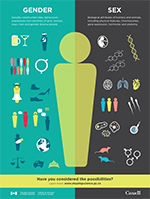
What is gender? What is sex? - CIHR

Brief science tangent: Biologically speaking, sex is more of a correlation of different traits than a simple description of what organs you have (intersex people exist!), what chromosomes you have (people can have XXY and all kinds of combinations!), what hormones are produced by your body, how your body responds to those hormones (not all people have functioning androgen receptors), how your secondary sex characteristics develop, and so on. Neurologically and physiologically, other sex differences are minimal, and only the extreme ends of the bell curves of each sex don't overlap. In other words, we're way more alike than we are different.

To encourage them to reflect more deeply on their biases, Espinosa exposed her students to articles about sexism and rape culture, and asked them to free-write stories about people facing gender or sexuality-based discrimination. They analyzed pieces of media and how they perpetuate stereotypes and expectations for young girls and boys.

Espinosa acknowledges that many of her students still expressed gender stereotypes by the end of the unit, but many of them began to start conversations on media they had seen recently that perpetuated stereotypes. Students still felt like sexism was too big of a problem to solve, but they made significant progress in thinking critically about the media they consume.

Friday, July 3, 2026

Introducing Prezi

Prezi is a mixture of a slideshow tool and a graphic design tool like Canva with a little extra spice. With Prezi, you create what is essentially one big image, and you can click through "slides" where each slide zooms in on a specific region of the image. It's incredibly useful for describing a journey (such as mapping the Hero's Journey with descriptions of each stage), mind-mapping, and anything that has a branching structure with main ideas, sub-ideas, and sub-ideas of the sub-ideas.

To use Prezi, you first create an account, which can be done through Google. On the home page, you will see the Prezi AI tool, but there are plenty of non-AI options as well:


Through the non-AI route, you select "Create new" and then choose a template or start from AI or from a blank:


Some templates can be used with AI while others are defaults:


Once you choose a template, you'll see the editing page, which allows you to rearrange the order of slides and add text, images, and transitions:


You can generate images with AI within the platform:


You can also have presenter notes:


Prezi can be used for essentially any subject as a fun alternative to Google Slides with more opportunities for play and creativity. It might be too complicated for younger students, but I think middle school and up would really benefit from this option.

Wednesday, July 1, 2026

Final Project Brainstorming

 My current top-of-mind idea for the final project is something I've been contemplating doing for a while: a class newsletter. I found that since I wasn't organized this year it was harder for me to help my students stay organized and catch up on missed work. Especially given the high rate of chronic absenteeism in my school, and the quick turnaround of the units in my curriculum, even a few missed assignments can really set a student back. I tried to help students catch up, but I was learning the curriculum myself week by week, so I couldn't help them as promptly or fully as I would like to be able to in the coming year. My concept would involve a weekly newsletter or a running Google Doc posted on Canvas with key vocabulary and concepts for the unit, as well as what we did every single week, and extra credit opportunities. My hope is this would serve as a way to keep myself organized and to help students who are absent or who work better outside of class.

My other idea is related to the project I did for Practitioner Action Research. Despite my complex feelings about AI, I can see the benefit of helping students access difficult scientific articles at a younger age via Perplexity. I really want my students to start learning about real-life scientific issues and innovations, like renewable energy or brain-computer interfaces. I'm thinking about doing a weekly project with my students where they find one research article through Google Scholar, put it into Perplexity to simplify the language, synthesize it in their own words, and (most importantly) form an opinion on the topic. I hope this will encourage my students to think critically about science and allow them to access "cool science" firsthand, while teaching them that AI can be a tool but it can't form your own opinions for you.

Perplexity Deep Research:


Tuesday, June 30, 2026

Christensen & Children's Media


What is your relationship to Barbie or any kind of children’s culture (like Disney?) How does Christensen validate or challenge your views?

Christensen’s perspective is largely the same as mine when I look back on my own experience with children’s media. Growing up, I was reading a wide variety of books, but my movie consumption was largely through Disney movies. Though I didn’t realize it until I was older, I was being taught even then that…

1. Romance is the thing that will save you if you are a girl.
2. Girls should dream of romance. Romance will get you your dreams. (Cinderella gets freedom from an abusive family through a man. Rapunzel gets freedom from her tower through a man. (Still one of my favorite movies though!) Jasmine gets freedom from the expectations of marriage through a man.
3. Main characters and important girls and women are skinny and conventionally attractive.
4. A man can love you even if you can’t speak (Ariel) or if he doesn’t know anything about you (Cinderella) or if you’re asleep (Sleeping Beauty) or dead (Snow White), and that’s true love.

As Christensen says, “Women’s roles in fairy tales distort reality.” There are many more subtle and not-so-subtle messages that I was taught through these movies, but when you are raised on them, it’s difficult to see where your desires end and the cultural messaging begins. For example, do I want a romantic relationship because I really want that specific form of partnership, or because I’ve been taught to value that above all else, or a mix of both? It’s uncomfortable to contemplate those questions because if the answer is different from what I’ve believed my whole life, it requires a reevaluation of my past and my plans for the future. Thus, I strongly related to Christensen’s student’s discussion of the dissection of dreams.


However, I also grew up on movies like Mulan, which challenged gender roles in a multitude of ways, and Frozen, which explicitly placed sisterhood and familial love over romantic love. Those are the taps on the class that demonstrate the importance of challenging, unconventional art in moving society forward. More recent Disney movies have also moved into unpacking complex parental and familial relationships beyond the stereotype of an evil stepmother (who is usually contrasted with the princess in a tale-as-old-as-time example of the Madonna-Whore Complex). Encanto is an example of that. Ultimately, when characters are treated as “just people” is when (I believe) we get the stories that stand the test of time. Not as boys or girls, not as a caricature of a certain race, but just as people experiencing life. Of course, the exception to this is when a person from an oppressed group wants to tell the story of their oppression, in which case identity does matter.

Monday, June 29, 2026

Response to Prensky and Spiegel

What do you make of the positions of Prensky and Spiegel?  Where do you stand on the “digital native” terminology?

The "digital native" terminology is interesting to me because of the general nature of the term "digital." Spiegel unpacks the varied ways one can be native, but does not mention that technology is constantly evolving. As we discussed in class, what was previously inconceivable with technology is constantly changing and becoming conceivable. Similarly, what was previously the cutting edge of digital technology is not the current cutting edge. For myself, I'm fairly native to movies and TV shows as well as YouTube and Instagram. However, the creation of TikTok and the popularity of short-form media in general has completely shifted what it means to be digitally native to the most updated technology. Now, with AI, that line is moving further, and I am no longer a digital native for that technology.


I did find it interesting that Spiegel points out that teens are generally motivated by socialization and connection, not by cool technology. I think for social media that is an understandable argument to make, but I would guess that teens would choose spending time with friends over being on social media pre-short form content. However, with TikTok, a lot of my students actively choose to scroll instead of talking to friends, and I wonder if the addictive nature of short-form content sets it apart from previous forms of digital media. With AI as well, I feel that the connection argument does not apply, unless you consider using AI as a way to shorten time spent on non-social activities. Overall, I suppose my point comes back to the idea that digital technology is always evolving and thus it's hard to make generalizations about one specific form of technology. Each one changes society in a unique way and has to be looked at alongside whatever else is going on in society at the time — for example, the rise in AI as it connects to the rise in anti-intellectualism and conservatism.

About Me

Sana, my Labradoodle: 


My instrument:

My music taste: 


Seventh Graders and Sexism

 "Seventh Graders and Sexism" by Lisa Espinosa Espinosa views teaching as a way to challenge students to think critically about so...